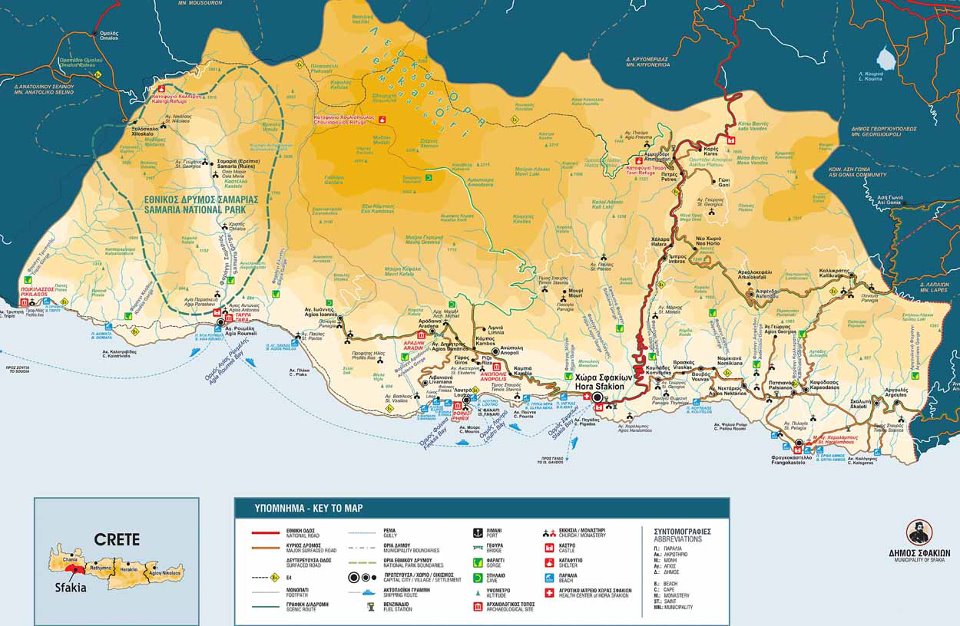
The wildest natural landscape in whole Crete. A unique place, difficult to approach, full of gorges and mountain peaks, but also with hidden spotlessly clean beaches with crystal clear waters. The unique formation of the ground played an important role in the life of the people of Sfakia. It had an effect on their temperament and as a result they created a unique civilization as we deduce from the ancient cities found in the area, such as Tarra, Phoinix, Aradena, Anopolis, Pikalissos, etc. The remains of a golden era lie in the gorges, the tablelands and the marvelous caves.
Almost all people of Sfakia claim that they come from noble Byzantine families who had been sent to Crete by the emperor. The big family of Skordilis had settled down in the wider area of Sfakia and they were the ancestors of many generations who still preserve a temperamental social diversion. People of Sfakia still preserve the ancient Cretan anthropological type.
The White Mountains (or Madares as the locals call it) take up almost the whole region of Sfakia, on the southeast of Chania prefecture, with more than 100 peaks, 57 of which are more than 2000m in height. Many of them are barren and covered in snow from autumn to spring. Here, on mountain Gigilos (2080m in height), Zeus the Kritagenis was said to have built his throne before moving it to the top of mountain Olympus (highest point: Pahnes 2.452m in height).
The word 'Sfakia' probably derives from the word 'sfaka', which is the local name for the evergreen oleander bush. Others believe that the word 'Sfakia' means 'the Land of Gorges' and that is because all these gorges with their unique and beautiful flora are typical of the area. In Chania prefecture there are almost 60 gorges, most of which are in Sfakia and are also the most imposing ones. Beginning from the west we find Tripiti gorge, which forms a natural border between Sfakia and Selino prefecture. Then there is Klados gorge. If you wish to walk through either of them, you will surely need an experienced guide.
However, the one and only gorge, as people of Sfakia say, is Samaria gorge, which has been declared a nature reserve since 1962. It is the largest gorge in Europe, 15km in length. Its width ranges from 3.5 to 150 metres and it is 500 metres in height. A very impressive feature of the gorge is the folds formed on the rocks.
The gorge contains rare species of flora and fauna, such as the Cretan wild goat (or Kri - Kri as the locals call it) as well as rare species of eagles and wild birds, which are all protected by international treaties.
You can visit the gorge only from May to October. There are more than 300.000 visitors every year. The path starts from Xiloskalo (at an altitude of 1200m) in Omalos tableland. After you go down 'ksiloskalo' you go on walking along the river through a wonderful forest with high trees and a magnificent view. 'Samaria' village lies in the middle of the gorge and it was abandoned in 1962 when the gorge was declared a nature reserve.
The area took its name after the Byzantine church of 'Osia Maria the Egyptian' (14th century) since the words 'osia' and 'Maria' can form the word Samaria. One of the nicest parts of the route is the "Doors" where there is a distance of only 3.5 metres between the two sides of the gorge and at that spot it is 500 metres in height.
Aradena gorge is smaller but equally beautiful. 150 metres above it there is the only metal bridge in Crete which is a meeting point for the lovers of bungee jumping as it is an ideal spot for their daredevil jumps.
For a milder hike, there is a diversity of wonderful small gorges taking 2-4 hours to cross such as Sfakiano, Imbros, Asfendou and Kallikratis gorge.
Kallergis, Houliopoulos and Tavri refuges are ideal for your mountain excursions as they can offer you a very comfortable accommodation.
During your hikes you will discover that there is an awful lot of hidden caves in this mountainous area, most of which still remain unexplored. Sfakia holds 260 caves out of 1400 existing in the whole prefecture of Chania. Many of them were used as hideouts during the Venetian domination, which lasted from the 13th to the 17th century, as well as during the Turkish domination. Isolated in this almost inaccessible area of the White Mountains, people in Sfakia villages managed to maintain a half-autonomous regime and although their houses were pillaged and they were slaughtered, they never succumbed to enslavement.